Periods Gone Public by Jennifer Weiss-Wolf
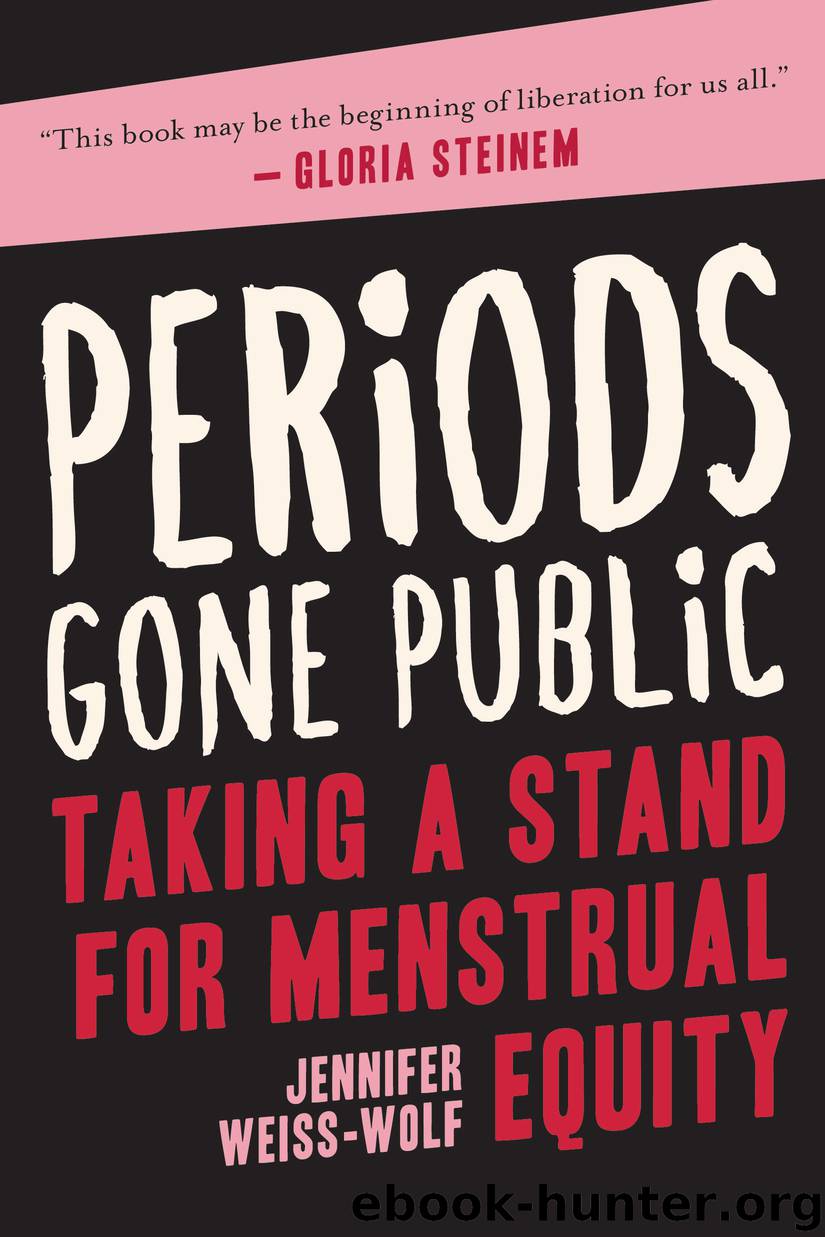
Author:Jennifer Weiss-Wolf
Language: eng
Format: epub
Publisher: Arcade Publishing
Published: 2017-04-04T04:00:00+00:00
Slow March of Progress
The evolution of menstrual product advances in the United States has been a sluggish, mostly uninspired slog: a burst of activity at the turn of the twentieth century, followed by simple advances every decade or so. Today the industry claims a more than $19 billion global market, a quarter of which is US based.2 The big guns and their domestic brands are all well-known household names—Procter & Gamble (Tampax, Always); Kimberly-Clark (Kotex); and Energizer Holdings (Playtex)—and together control 85 percent of the market. Johnson & Johnson, the other longtime player, sold off its brands—Stayfree, Carefree, and o.b.—in 2013. Not surprisingly, tampons and pads comprise the vast majority of the domestic market and, between the two, pads are the preferred option; a study by the Centers for Disease Control indicates that pads (62 percent) are more popular in the United States than tampons (42 percent).3
To get you up to speed, here’s a quick, condensed timeline of product progress over the past hundred-plus years. The very first commercial pad was produced and marketed in 1896, made out of cotton muslin and manufactured under the name “Lister’s Towels” by Johnson & Johnson, in honor of scientist Joseph Lister, the same namesake of Listerine mouthwash. Kimberly-Clark’s Kotex-brand disposable pads, made with absorbent cellulose, the name intended to reflect the intersection of “cotton” and “texture,” were launched in 1920. Just over a decade later, tampons made of compressed cotton, featuring cardboard applicators and removal strings, were patented in 1931 under Procter & Gamble’s behemoth Tampax brand (the name, here, a medicinal sounding combination of “tampon” and “vaginal packs”).
Over the next seventy years, each of these products saw a series of incremental improvements. Belts to secure pads went by the wayside in the early 1970s; the inaugural version of these self-stick pads, Stayfree minis, was introduced the same year Neil Armstrong landed on the moon (as the saying goes, “If we can put a man on the moon …”). Slimmer pads, individually encased pads, dri-weave pads, and the ultimate stain-blocker—pads with wings!—came on the scene every five to ten years throughout the latter part of the century.
Meanwhile, the 1970s marked the replacement of cardboard tampon applicators with pearly domed plastic, followed by no-applicator tampons, the o.b. brand (which translates from the German ohne binde or no pad). Deodorant tampons with chemically induced “fresh scents” to mask supposed odors also were marketed. In the 1980s, absorbency classifications from “junior” to “super” became part of the legally mandated tampon vernacular in response to the spate of toxic shock syndrome cases caused by super-absorbent synthetic tampons. From the late 1990s up through the present came more patented perks like “leakguard braid” removal strings and compact applicators—even specially marketed, softer, quieter wrappers. That’s about it.
Organic and toxin-free tampons and pads have occupied a small, but growing corner of the mass market since being first introduced by the British company Natracare in 1989. And a handful of alternative products have enjoyed a limited, though fiercely loyal, following. With
Download
This site does not store any files on its server. We only index and link to content provided by other sites. Please contact the content providers to delete copyright contents if any and email us, we'll remove relevant links or contents immediately.
| Anthropology | Archaeology |
| Philosophy | Politics & Government |
| Social Sciences | Sociology |
| Women's Studies |
The Rules Do Not Apply by Ariel Levy(4969)
On the Front Line with the Women Who Fight Back by Stacey Dooley(4873)
The Lonely City by Olivia Laing(4802)
Bluets by Maggie Nelson(4559)
The Confidence Code by Katty Kay(4262)
Three Women by Lisa Taddeo(3434)
Not a Diet Book by James Smith(3429)
Inferior by Angela Saini(3316)
Confessions of a Video Vixen by Karrine Steffans(3309)
A Woman Makes a Plan by Maye Musk(3254)
Pledged by Alexandra Robbins(3179)
Wild Words from Wild Women by Stephens Autumn(3153)
Nice Girls Don't Get the Corner Office by Lois P. Frankel(3044)
Brave by Rose McGowan(2825)
Women & Power by Mary Beard(2767)
Why I Am Not a Feminist by Jessa Crispin(2760)
The Girl in the Spider's Web: A Lisbeth Salander novel, continuing Stieg Larsson's Millennium Series by Lagercrantz David(2723)
The Clitoral Truth: The Secret World at Your Fingertips by Rebecca Chalker(2720)
I Who Have Never Known Men by Jacqueline Harpman(2670)
